Context
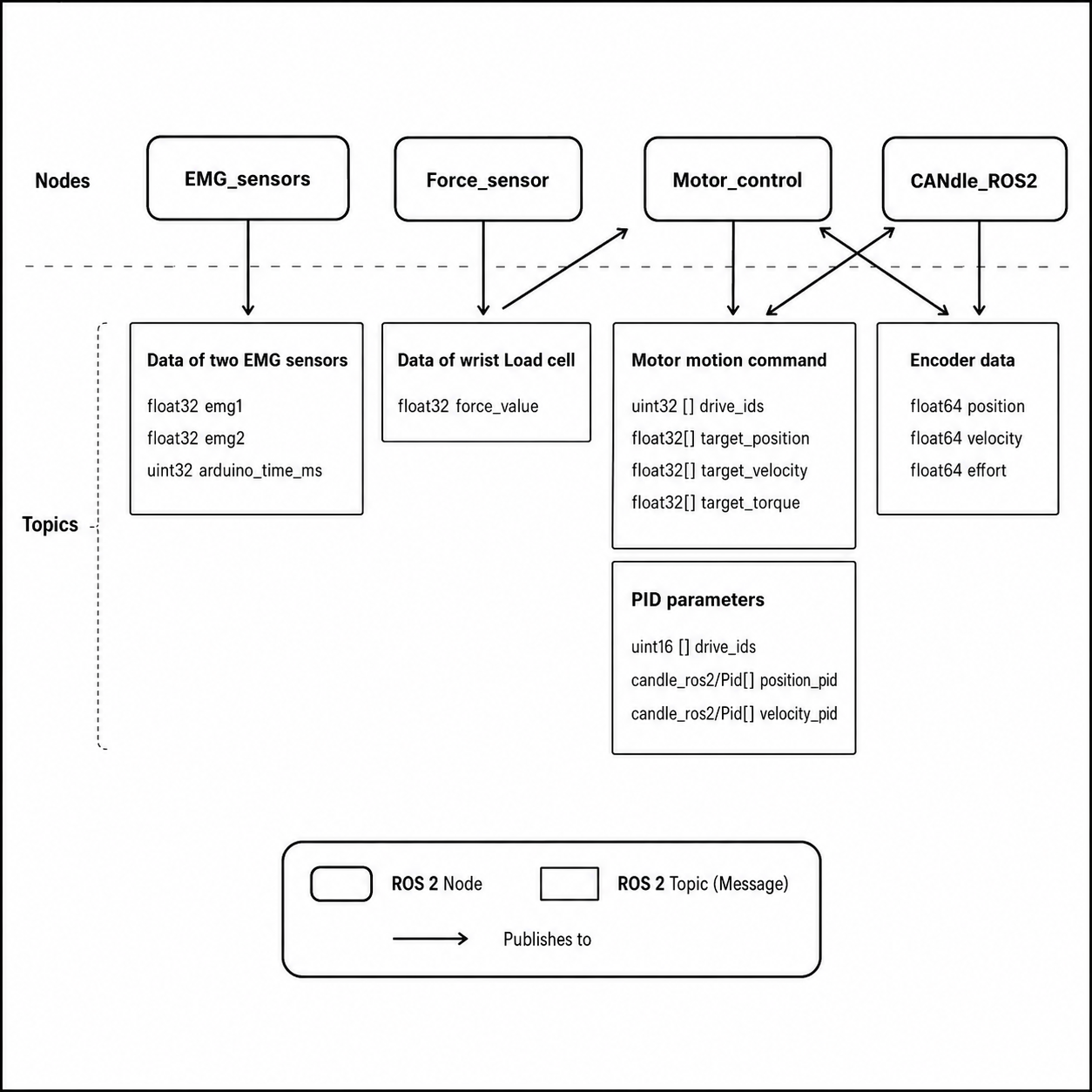
Carried out as part of my PhD at LISV — Université Paris-Saclay (2022–2026). The exoskeleton required a robust, real-time software backbone capable of synchronising motor commands, EMG data, force measurements and high-level control logic across multiple processors.
Architecture
- Raspberry Pi (embedded) running low-level motor and sensor nodes via CAN Bus
- Host workstation running high-level control, visualisation and logging nodes
- Inter-machine communication via ROS2 DDS over Ethernet
Responsibilities
- Implemented ROS2 nodes in C++ and Python for motor control, sensor acquisition and assistance logic
- Configured multi-machine ROS2 discovery and DDS tuning for stable real-time operation
- Integrated EMG and force sensor data streams into the control loop
- Built rosbag2 recording pipelines for all experimental sessions
- Developed RViz2/rqt dashboards for real-time monitoring and debugging
Key Results
- Stable and modular software platform supporting all experimental phases of the PhD
- Reproducible data acquisition pipeline (rosbag2) used across 5+ user studies
- Clean separation between real-time control (C++) and data-analysis layers (Python)
Technologies
ROS2 · C++ · Python · Raspberry Pi · CAN Bus · EtherCAT · Linux · rosbag2 · rqt · RViz2