Nada Salman
PhD in robotics, Université Paris-Saclay · Île-de-France

I design, build and control wearable robots: from SolidWorks and STM32 firmware to ROS 2 architectures, EMG-driven assistance and experiments with people.
I trained as a mechatronics engineer at the University of Lattakia, then specialised in medical robotics at the University of Strasbourg, where my master's project at ICube developed adaptive EMG-based control for a haptic rehabilitation interface.
My PhD at LISV, Université Paris-Saclay (2022–2026), designed, built and controlled an active upper-limb exoskeleton for elbow assistance and gravity compensation: mechanical design, motor and sensor integration, a distributed ROS 2 architecture, adaptive impedance and admittance control, and trials with participants. Alongside it I taught more than 200 hours at ESILV and UVSQ.
Publications
Selected publications.
- ICARA2026
Real-Time Neuro-Motor Index Modulation for Adaptive Admittance Control in Upper-Limb Exoskeletons
2026 7th International Conference on Automation, Robotics and Applications (ICARA) · 2026
DOIAbstract
This paper presents a real-time method for neuro-motor index modulation to enable adaptive admittance control in upper-limb exoskeletons, using surface EMG signals to continuously adapt assistance levels during motor tasks.
BibTeX
@inproceedings{salman2026neuro, abbr = {ICARA}, bibtex_show = {true}, title = {Real-Time Neuro-Motor Index Modulation for Adaptive Admittance Control in Upper-Limb Exoskeletons}, author = {SALMAN, Nada and Charafeddine, Jinane and Venkateswaran, Swaminath and Benali, Abderraouf}, booktitle = {2026 7th International Conference on Automation, Robotics and Applications (ICARA)}, year = {2026}, publisher = {IEEE}, doi = {10.1109/ICARA69401.2026.11480345}, html = {https://doi.org/10.1109/ICARA69401.2026.11480345}, selected = {true}, abstract = {This paper presents a real-time method for neuro-motor index modulation to enable adaptive admittance control in upper-limb exoskeletons, using surface EMG signals to continuously adapt assistance levels during motor tasks.} } - RO-MAN2024
Adaptive Weight Compensation in Assistive Upper-Limb Exoskeletons: an EMG Analysis
2024 33rd IEEE International Conference on Robot and Human Interactive Communication (RO-MAN) · 2024
DOIAbstract
We analyse surface EMG signals to drive adaptive weight compensation in an assistive upper-limb exoskeleton, demonstrating automatic assistance adaptation during flexion-extension movements with load.
BibTeX
@inproceedings{salman2024adaptive,
  abbr        = {RO-MAN},
  bibtex_show = {true},
  title       = {Adaptive Weight Compensation in Assistive Upper-Limb Exoskeletons: an EMG Analysis},
  author      = {SALMAN, Nada and Benali, Abderraouf},
  booktitle   = {2024 33rd IEEE International Conference on Robot and Human Interactive Communication (RO-MAN)},
  year        = {2024},
  publisher   = {IEEE},
  doi         = {10.1109/RO-MAN60168.2024.10731414},
  html        = {https://doi.org/10.1109/RO-MAN60168.2024.10731414},
  selected    = {true},
  abstract    = {We analyse surface EMG signals to drive adaptive weight compensation in an assistive upper-limb exoskeleton, demonstrating automatic assistance adaptation during flexion-extension movements with load.}
}
Selected work
Selected projects.
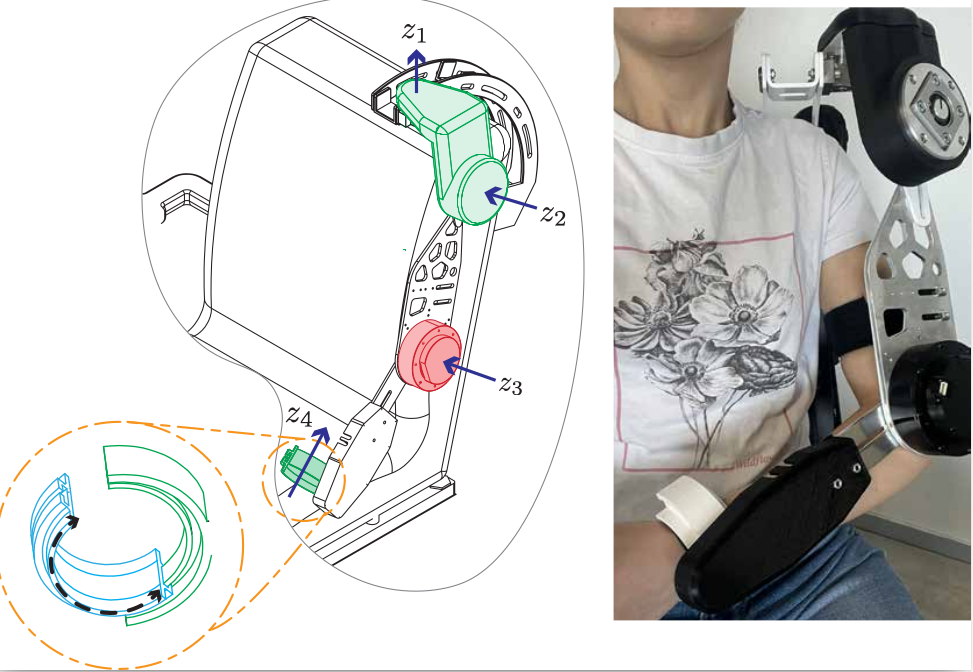 Active Upper-Limb ExoskeletonDesign, mechatronic integration and control of an active elbow exoskeleton for motion assistance and gravity compensation.read moreRobotics software
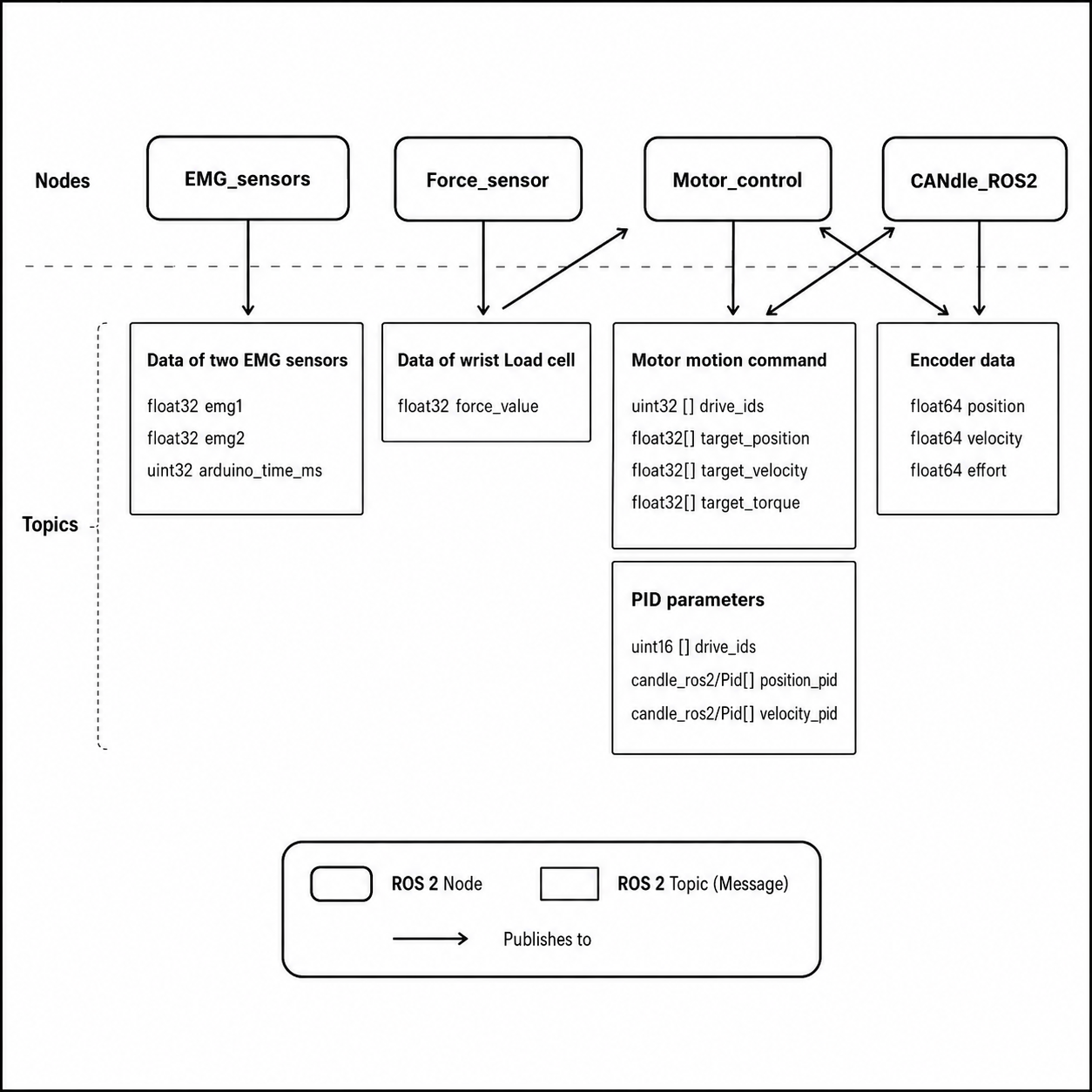 ROS2 Distributed Architecture for ExoskeletonDesign and implementation of a modular, distributed ROS2 software stack connecting motor control, sensors and assistance algorithms.read moreEMG & signal processing
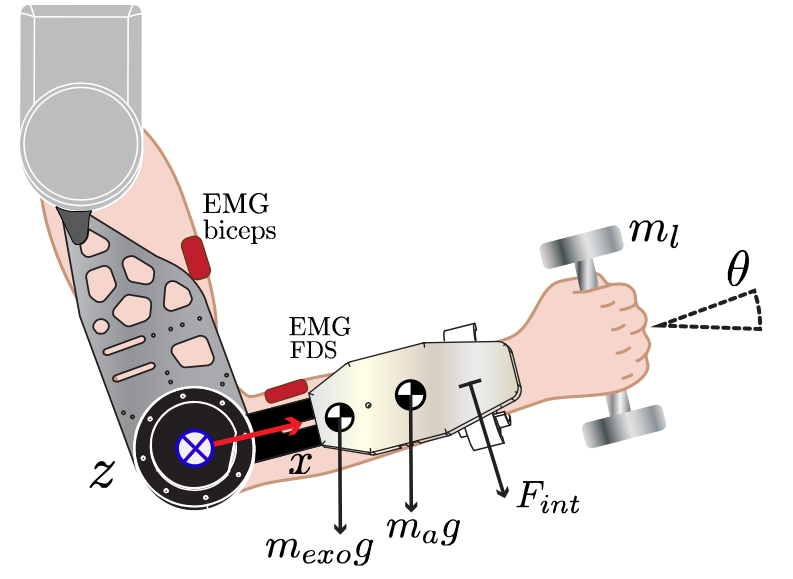 Real-Time Load Estimation from EMGOnline load estimation using surface EMG to automatically adapt exoskeleton assistance — fuzzy-logic approach with per-user calibration.read moreMechanical design
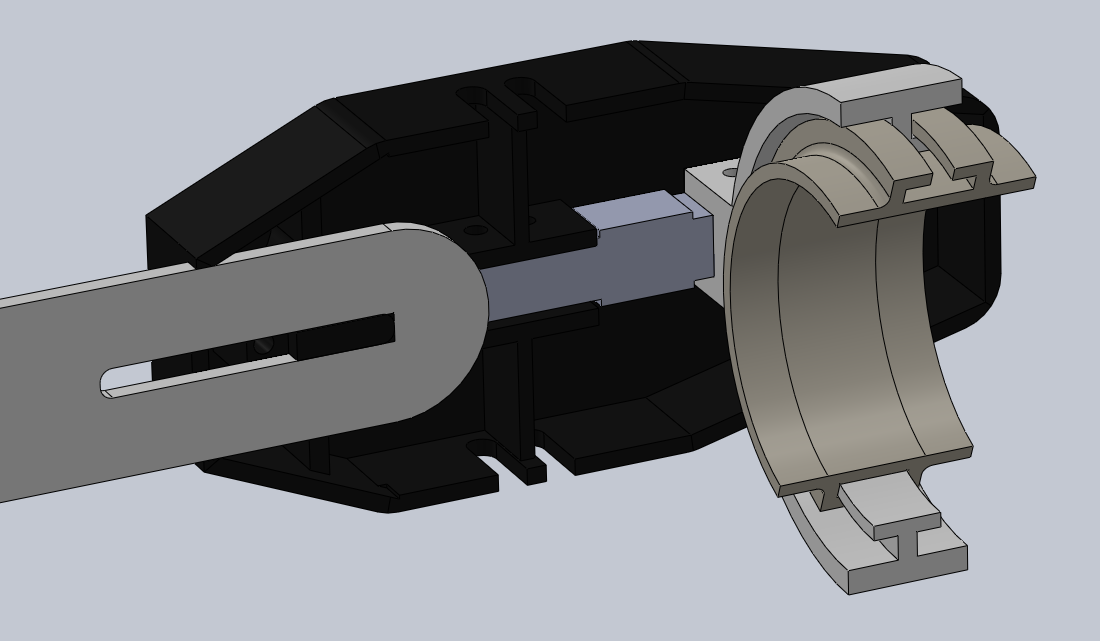 Exoskeleton Mechanical Design (Multi-Generation)Iterative mechanical redesign of the upper-limb exoskeleton — kinematic compatibility, adjustability, passive DOFs at shoulder and wrist.read more