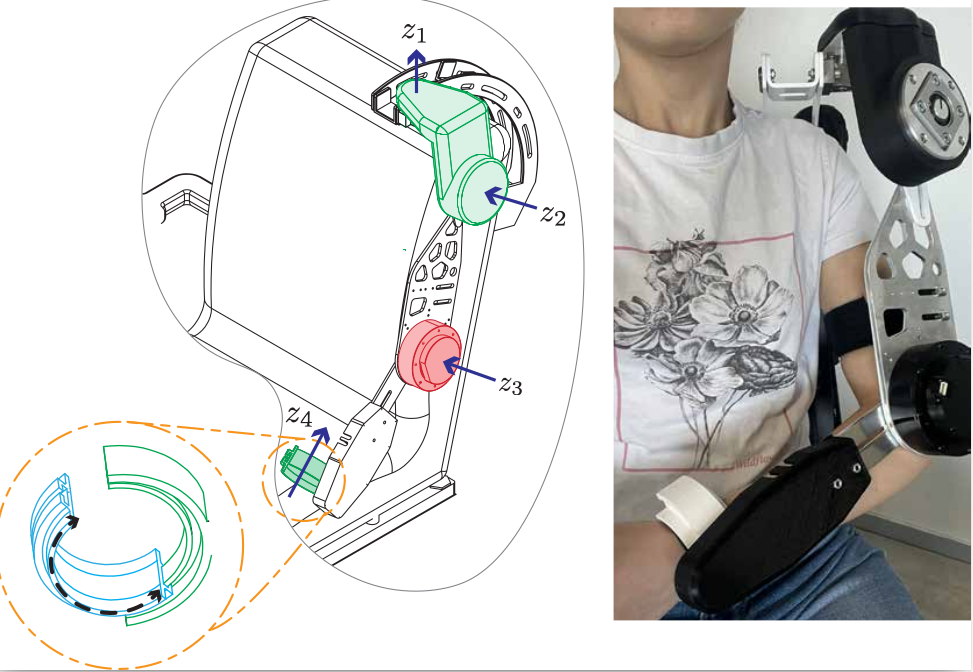
Context
Developed during my PhD at LISV — Université Paris-Saclay (2022–2026). The goal was to build a wearable robotic device capable of assisting elbow flexion/extension and compensating the weight of held loads during activities of daily living (ADL), with a focus on supporting workers or people with reduced muscle strength.
Responsibilities
- Mechanical architecture design and integration of the AK80-8 motor with MD80 controller
- SolidWorks CAD for exoskeleton structure; 3D-printed and machined parts
- Development of the full ROS2 software architecture (C++ and Python nodes on Raspberry Pi)
- Integration of surface EMG sensors and a 6-axis force sensor into the control loop
- Impedance/admittance control and gravity-compensation algorithm
- Experimental trials with healthy participants
Key Results
- Functional exoskeleton prototype validated on 10+ healthy participants
- Modular experimental platform used across multiple control studies
- Multiple mechanical redesigns improving kinematic compatibility and user adaptability
Technologies
ROS2 · C++ · Python · Raspberry Pi · CAN Bus · AK80-8 · MD80 · Linux · SolidWorks · Gazebo
{% cite salman2026neuro %} {% cite salman2024adaptive %}