Context
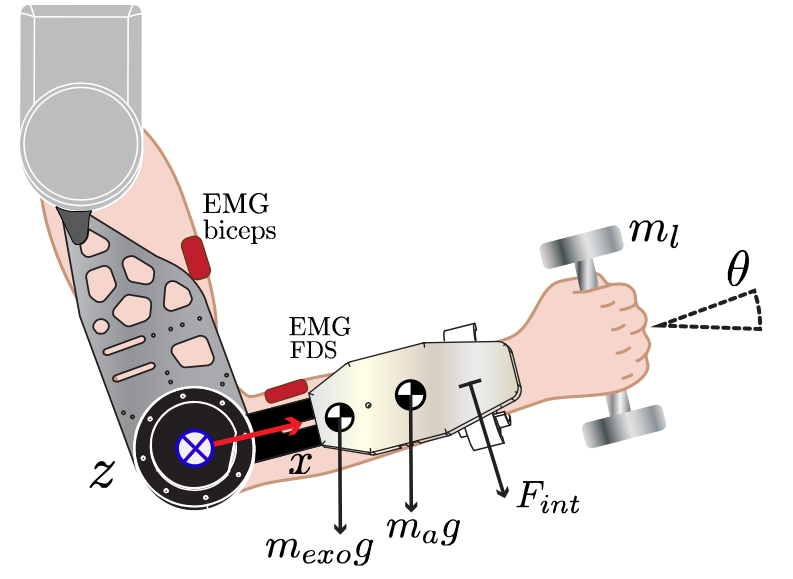
Developed during my PhD at LISV (2022–2026). One of the core challenges in assistive exoskeletons is knowing how much the user needs: estimating the weight of a held object in real time without dedicated load cells at the hand. The solution exploits the relationship between muscle activity (EMG) and external load.
Approach
- Signal acquisition — 4-channel surface EMG from biceps brachii and anterior deltoid
- Preprocessing — Butterworth bandpass filtering (20–450 Hz), RMS and variance feature extraction
- Fuzzy-logic estimator — maps EMG features to load estimate with linguistically interpretable rules
- Per-user calibration — 2-minute calibration session maps individual muscle patterns to reference loads
- Online adaptation — estimated load fed in real time to the gravity-compensation algorithm
Key Results
- Reliable online load estimation over 0–3 kg range during elbow flexion/extension
- Automatic assistance adaptation without any physical load sensor at the hand
- Validated on healthy participants in flexion/extension tasks
Technologies
Python · MATLAB · Surface EMG · Digital signal processing · Fuzzy logic · ROS2
{% cite salman2024adaptive %}